

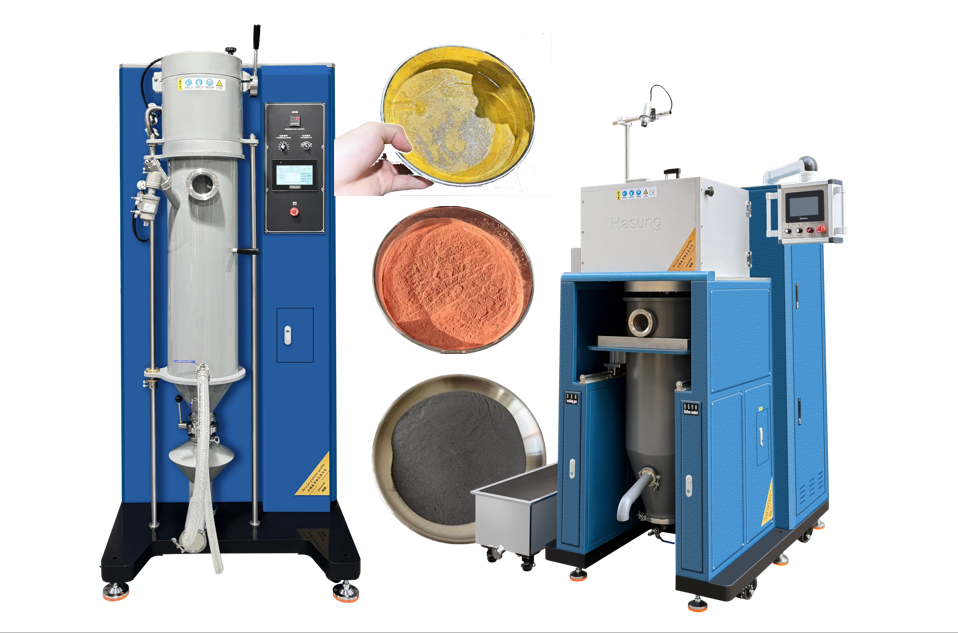
Metal powders play an indispensable role in contemporary manufacturing. As one of the important technologies for producing metal powders, water atomization has become a mainstream choice in industrial production due to its high efficiency, controllable cost, and wide applicability of materials. Water atomization metal powder equipment uses high – pressure water jets to break up molten metal streams and rapidly cool them, producing fine, irregularly shaped powder particles. Due to their unique physical and chemical properties, such powders find applications in various industries, including jewelry soldering and electronic device manufacturing.
Production Process and Technical Characteristics of Water Atomization Metal Powder
The production process of water atomization equipment begins with the melting of metals or alloys. Upon reaching the required temperature, the molten metal forms a thin stream through a tundish. High – pressure water jets impact the metal stream from multiple angles, dispersing it into tiny droplets. These droplets rapidly cool and solidify during flight, forming metal powder. By adjusting water pressure, temperature, metal flow rate, and nozzle design, the particle size distribution and shape of the powder can be controlled.
Application in Jewelry Soldering
Jewelry manufacturing imposes strict requirements on material purity, workability, and final appearance. Water atomization metal powder is primarily used in this field for producing solder.
Jewelry soldering requires solders with different melting points to enable step – by – step soldering. Water atomization equipment can produce precious metal alloy powders such as gold, silver, and platinum. These powders are mixed with flux to form solder paste, which is applied to the joints of jewelry. The irregular shape of the powder enhances the adhesion of the solder paste, ensuring accurate solder placement. Furthermore, the water atomization process allows precise control over alloy composition, guaranteeing that the solder’s fineness and melting characteristics meet standards.
For jewelry with intricate patterns or multi – component assemblies, using powder – based solder enables high – precision soldering and reduces subsequent finishing processes. In modern jewelry production, laser welding techniques often use metal powder as filler material. The uniform particle size of water – atomized powder contributes to forming smooth weld seams.
Key Role in Electronic Device Manufacturing
The electronics industry is a significant application field for water atomization metal powder, with specific uses including:
1.Electronic Packaging and Conductive Adhesives
Microelectronic packaging requires connection materials with high conductivity and stability. Water – atomized silver and copper powders, due to their large specific surface area and good sintering activity, are used to prepare conductive adhesives and conductive inks. These materials are applied in components such as printed circuit boards, membrane switches, and RFID tags. The irregular shape of the powder enhances inter – particle contact, improving the reliability of the conductive network.
2.Thermal Management Materials
As the power density of electronic devices increases, thermal management becomes crucial. Water – atomized copper and aluminum powders can be used to prepare thermal interface materials with high thermal conductivity, filling the gap between chips and heat sinks to reduce contact thermal resistance. Graded particle size design can maximize packing density and optimize heat conduction paths.
3.Electrodes for Multilayer Ceramic Capacitors
Multilayer ceramic capacitors are fundamental components in electronic circuits. Water – atomized nickel and copper powders are used to fabricate internal electrodes. Their good sintering compatibility with ceramic layers enables the miniaturization and high capacitance of these components.
4.Additive Manufacturing
Some special structural parts in electronic devices are produced using metal additive manufacturing technologies. Water – atomized stainless steel and aluminum alloy powders can be used in selective laser melting processes to manufacture components such as heat sinks, housings, and connectors. The powder’s flowability, packing density, and particle size distribution directly affect the precision and performance of the fabricated parts.
5.Battery Materials
In the production of cathode and anode materials for lithium – ion batteries, water atomization technology can be used to produce metal or alloy powders with specific structures, serving as carriers for active electrode materials or conductive additives.
Technological Development and Application Prospects
Technological advancements in water atomization metal powder equipment focus on improving powder purity, controlling particle size distribution, reducing oxygen content, and expanding the range of processable alloys. Innovations in nozzle design, online monitoring systems, and optimization of post – processing techniques are further expanding the application fields of water – atomized powders.
In the future, as electronic devices trend toward higher frequencies and power densities, and jewelry manufacturing moves toward greater customization and precision, the demand for water – atomized metal powders is expected to continue growing. Simultaneously, driven by concepts of green manufacturing and the circular economy, the potential of water atomization technology in processing recycled metals and reducing material waste will also be further developed.
Conclusion
Powder materials produced by water atomization metal powder equipment, leveraging their controllable physicochemical properties, play a crucial role in industries requiring precision and reliability, such as jewelry soldering and electronic device manufacturing. From jewelry solder to electronic packaging materials, from thermal management components to battery electrodes, water atomization technology, through continuous innovation, constantly meets the stringent material performance requirements of high – end manufacturing. It has become an indispensable link in the modern industrial supply chain. With the deepening of application technologies and the refinement of equipment processes, water – atomized metal powders will continue to provide the material foundation for technological progress across multiple industries.
Post time: Dec-24-2025


